Recycling and Sustainability — Commercial Waste Barking
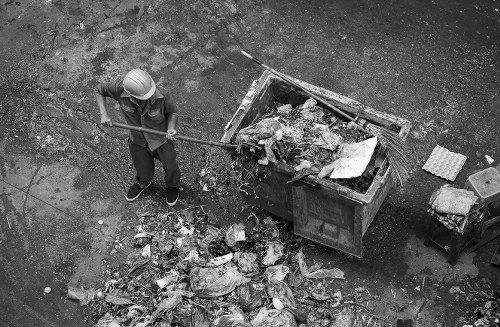 At Commercial Waste Barking we prioritise an eco-friendly waste disposal area ethos that supports local businesses, borough initiatives and a cleaner urban environment. Our sustainability plan aligns with the borough's approach to waste separation, encouraging source segregation of organics, paper, plastics and mixed recyclables from commercial properties. We work with local engineers and planners to improve collection routes and minimise landfill dependency while supporting the move toward a true sustainable rubbish area across Barking and nearby boroughs.
Our targets are clear and measurable: we aim for a 55% recycling percentage target across all commercial streams within three years, rising to 65% within five years where practical. These targets are based on local waste composition audits and mirror ambitions set by neighbouring boroughs for mixed dry recycling and food waste streams. By setting a bold, data-driven target we create accountability and a roadmap for businesses seeking greener commercial waste in Barking.
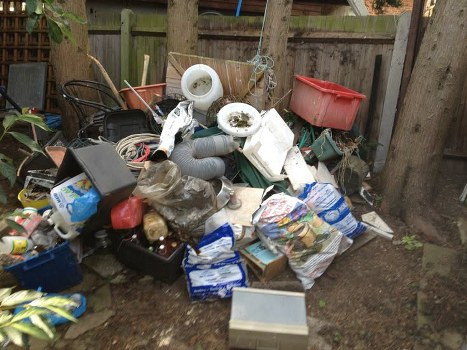 We partner with a network of local transfer stations and resource recovery centres to ensure that materials collected in the borough are handled responsibly. These local transfer stations act as hubs for sorting, baling and onward transport to recycling facilities, reducing unnecessary long-distance movements and associated emissions. Through these partnerships we can monitor material flows, improve capture rates for glass and cardboard, and ensure construction and demolition waste is diverted into specialist recycling streams.
Practical Steps for a Low-Carbon, Sustainable Rubbish Area
Commercial customers receive tailored collection plans that reflect their industry, waste volumes and segregation capabilities. Our approach to Barking commercial waste includes provision of labelled containers, advice on sorting by waste type, and regular audits that help businesses reduce contamination in recycling bins. A combination of education, incentives and infrastructure upgrades delivers better recycling outcomes and a more efficient eco-friendly waste disposal area overall.
We also foster community partnerships that expand the lifecycle of goods. Small changes can have big impacts: consolidated collections, bulk cardboard flattening, and dedicated food waste caddies significantly increase recycling rates. In addition, we maintain a list of approved outlets for specific streams — such as organics processors, paper mills and metal recyclers — to keep materials moving through closed-loop systems.
 A central pillar of our sustainability work is collaboration with local charities and social enterprises. We work with non-profits that run reuse schemes, furniture redistribution and electronics refurbishment programmes, enabling businesses to donate usable items instead of sending them to disposal. These partnerships not only support local communities, but they also help reduce CO2e by extending product lifespans and diverting valuable materials from heavyweight waste streams.
Transport, Technologies and Local Cooperation
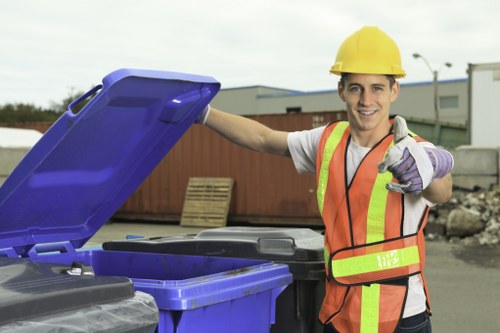 Our fleet strategy reflects our commitment to a low-carbon approach: an increasing share of low-carbon vans and Euro-6 vehicles are deployed on urban rounds to reduce emissions and local air pollution. Route optimisation software, combined with scheduled consolidated pickups, lowers mileage and supports our sustainability ambitions for commercial waste in Barking and surrounding districts. We encourage clients to consolidate small daily outputs into fewer scheduled lifts where feasible, reducing vehicle movements.
Initiatives include:
- Dedicated organic collections for food service businesses and hospitality outlets;
- Segregated paper and cardboard streams for offices and retail;
- Construction waste management plans that increase reuse and recycling of inert materials.
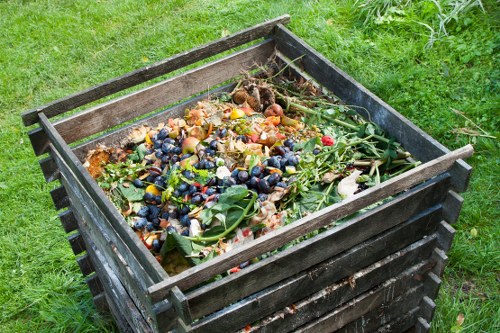 Working close to local authorities and borough waste teams, our services support region-wide strategies — from kerbside-style segregation pilots for businesses to pilot bulky waste reuse schemes. We welcome collaborative efforts with municipal waste teams to align policies and share best practices, which is essential for scaling up performance. By linking businesses to charities, local transfer stations and low-emission transport options, Commercial Waste Barking creates an integrated network that delivers measurable environmental results.
Our promise is simple: reduce landfill dependency, improve recycling performance and provide practical, cost-effective solutions for an eco-conscious commercial community. Through transparent reporting, regular route reviews and ongoing partnerships with local transfer stations and community organisations, we aim to set a new standard for sustainable rubbish areas in east London. Whether you're seeking advice on segregating recyclables, arranging a food waste service or exploring reuse partnerships, our strategy is focused on outcomes that benefit businesses, residents and the planet.
Ultimately, the success of a green commercial waste programme depends on cooperation. When businesses adopt best practice, when charities reclaim usable goods, and when low-carbon vans replace older fleets, the cumulative effect is a healthier urban environment and a resilient circular economy. Commercial Waste Barking remains committed to these objectives and to the continuous improvement required to meet and exceed our recycling percentage target.
We invite organisations across the borough to join us in creating a thriving, low-impact approach to waste. By working together — borough teams, transfer stations, charities, businesses and hauliers — we can transform the local approach to commercial waste into a measurable, long-term sustainability success.
